
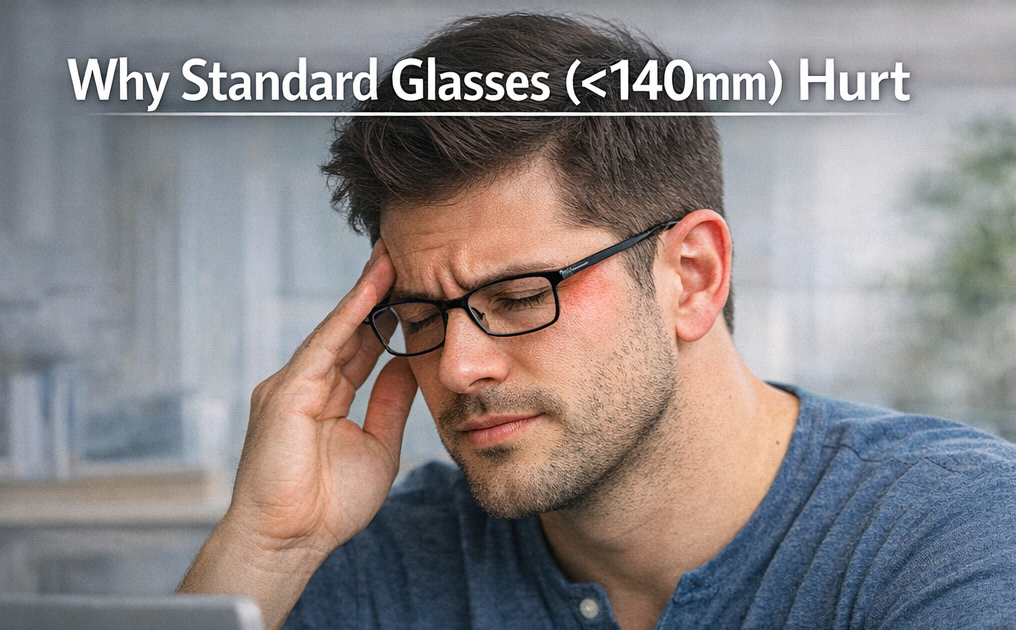
Why Standard Glasses (<140mm) Hurt: Top 5 Pain Points Explained

1. First, let’s get clear: Why do “standard glasses” make you uncomfortable?
A lot of people think discomfort from glasses is just an “adjustment issue.” But the truth is way simpler:
👉 Most of the time, it’s a bad size fit—not that you can’t adjust to them.
Most “standard eyeglass frames” on the market have a total width of:
👉 Less than 140mm
This size is made for medium to narrow heads by default.
If you have a wider face or a slightly bigger head, here’s what happens:
👉 The frame gets stretched out nonstop → it bends a little → the pressure shifts around.
The end result?
👉 The discomfort isn’t immediate—it’s constant, built-up pressure from the frame’s structure.
2. Self-Check: Do You Have a Size Mismatch?
If you have 2–3 of these issues, you’re probably dealing with a size problem:
-
Starts feeling tight after wearing them a while
-
Noticeable pressure on your temples
-
Pain behind or above your ears
-
Indentations on your nose bridge
-
You keep adjusting them without even thinking
-
The longer you wear them, the more you want to take them off
👉 Chances are, your glasses just don’t fit right size-wise.
3. Top 5 Common Discomforts (Breakdown of Structural Causes)

3.1 Temple Pressure (Built-Up Constant Pressure)
How it happens:
The frame is narrower than your head → the temple arms get stretched out nonstop → all the pressure sits on one spot at your temples.
What you feel:
-
Mild tightness at first
-
Starts aching after about an hour
-
Headaches or a tight feeling if you wear them all day
Trigger scenarios:
-
Walking to work (even minor shaking makes the pressure worse)
-
Staring at screens for hours (constant pressure on your temples)
-
Working with your head down (pressure gets worse as the frame shifts forward)
3.2 Ear Pain (Misaligned Pressure Path)
How it happens:
When the frame is stretched, it gets unbalanced → the weight shifts from the frame to the spots behind your ears.
What you feel:
-
Tenderness above your ears
-
Aching behind your ears
-
Hurts way more when you wear headphones or a hat
Trigger scenarios:
-
Commuting with headphones (double the pressure)
-
Sweating in summer (more friction = more discomfort)
-
Wearing glasses nonstop for hours
3.3 Nose Bridge Indentations (Too Much Local Pressure)
How it happens:
The nose pads are too narrow + they don’t touch much of your nose → all the weight sits on two tiny spots.
What you feel:
-
Redness on your nose bridge
-
Clear indentations
-
Pain or discomfort after wearing them for a long time
Trigger scenarios:
-
Working at a desk for hours
-
Looking down frequently
-
Hot, sweaty days (more friction makes it worse)
3.4 Headaches & Eye Strain (Unstable Visual Alignment)
How it happens:
The frame bends a little → the center of the lenses isn’t lined up with your pupils → your eyes keep adjusting to compensate.
What you feel:
-
Eyes get more tired the longer you stare at a screen
-
Harder to focus
-
You can feel your eyes straining
Trigger scenarios:
-
Working on a computer for hours
-
Using your eyes at night
-
Reading or focusing on one task for a long time
3.5 Constant Slipping (Structural Imbalance)
How it happens:
The frame gets stretched out nonstop → it loses its stretch + the weight shifts forward → the nose pads end up carrying too much.
What you feel:
-
You’re always pushing them up
-
They slip even when you move a little
-
The more you adjust them, the more unstable they get
Trigger scenarios:
-
Walking or exercising
-
Making a lot of facial expressions
-
Oily or sweaty nose bridge
4. Actually Effective Solutions (In Order of Priority)
4.1 Fix It at the Source: Choose a Better Frame Width
👉 Go for frames with a bigger total width (usually ≥140mm)
Best for:
-
Wider face shapes
-
Wearing glasses for long stretches (work, driving, studying)
-
People who care about comfort
A lot of people say this after switching frames:
👉 You’ll stop even noticing you’re wearing glasses.
4.2 Temporary Adjustments (Short-Term Relief)
-
👉 Widen the temple arms a little → less pressure on your temples
-
👉 Soft nose pads or stick-on pads → spreads out the pressure on your nose
-
👉 Adjust the angle of the nose pads → better pressure distribution
👉 But here’s the thing:
These fixes only ease the pressure—they don’t fix the real structural problem.
5. A Key Mindset Shift
👉 A really well-fitting pair of glasses should feel almost invisible.
If you:
-
Constantly notice your glasses
-
Have to adjust them all the time
-
Feel obvious discomfort after wearing them a while
👉 It’s usually not about adjusting—it’s about the fit being off structurally.
6. Summary
If your frame is less than 140mm wide and you’re uncomfortable:
👉 First check if the size fits—not if you can “get used to it.”

Quick takeaway:
-
Temple pain → frame’s too narrow
-
Ear pain → misaligned pressure
-
Nose pain → too much pressure in one spot
-
Headaches → lenses aren’t lined up with your pupils
-
Slipping → structural imbalance
👉 The real problem is almost always the same:
The size is wrong.
Share:
Is “Virtual Try-On” Reliable for Wide Frames? We Investigate.
The Ultimate Guide for Men with Wide Faces: 7 Steps from Measurement to Try-On